
3rd July 2013
New for Old
 Many advisers are focusing more on protection this year as it has yet to shudder to the touch of the RDR’s clammy hand.
One matter that dissuades many from doing more than dipping their toe into the protection waters is the perceived complexity of both critical illness and income protection plans. With critical illness the market is ever changing. Insurers regularly upgrade their plans adding new conditions or altering the wordings of existing conditions and few advisers are able to keep on top of this barrage of changes.
This constant shifting reduces the confidence of many advisers and indirectly led me to start the CIExpert website which enables advisers to compare current critical illness products as well as current versus older plans.
Most advisers consider the site as essential for compliance purposes as it allows an audit trail to be compiled however fail to see its use as a sales tool.
Consider how many older critical illness plans are in existence. How many of these are provably inferior to todays more comprehensive versions? One of the concerns that disturbs advisers and prevents them from considering any re-broking exercise is the potential for replacing a superior older plan with something that is less effective.
Between November 2001 and April 2007 all mainstream providers removed early stage prostate cancer and/or angioplasty cover from their policies. These two conditions impact primarily on men aged over 50, and particularly on smokers, and this an important area to assess when undertaking comparisons.
The effect of losing these two valuable plan aspects is such that even plans considered mediocre in the late 1990s and early 2000s may prove superior to current plans for older men. An example of this is shown below
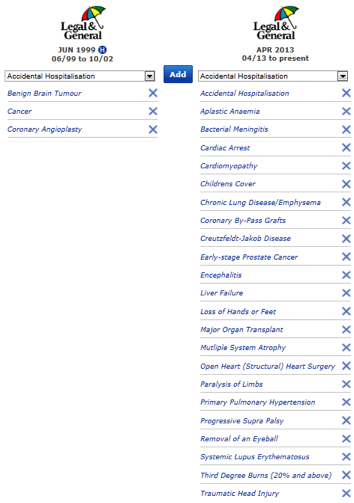
Comparing the current Friends Life policy with the March 2000-February 2001 Friends Provident version highlights 30 conditions that the older plan either doesn’t have or has with a marked inferior claims wording. However the value of all these is outweighed by the impact of the two areas where the earlier plan beats today’s version – cancer and, angioplasty.
The current plan provides up to £25,000 if undergoing treatment for early stage prostate cancer whereas the older plan not only covers the full sum assured - £100,000 in the example above – but also pays out purely on diagnosis.
A similar situation occurs with virtually all current plans and their year 2000 counterparts.
Interestingly this is not the case for females and in most instances the current plans are distinctly superior to earlier versions. So, great care needs to be taken when re-broking and, tangentially, this also highlights why two single life plans are preferable to a joint life version.
Claims management companies are avidly searching for financial products where new complaints can be levelled. Don’t offer food for their insatiable opportunist appetites.
Alan Lakey
CI Expert.
Not yet registered?
Please complete this form to join our community